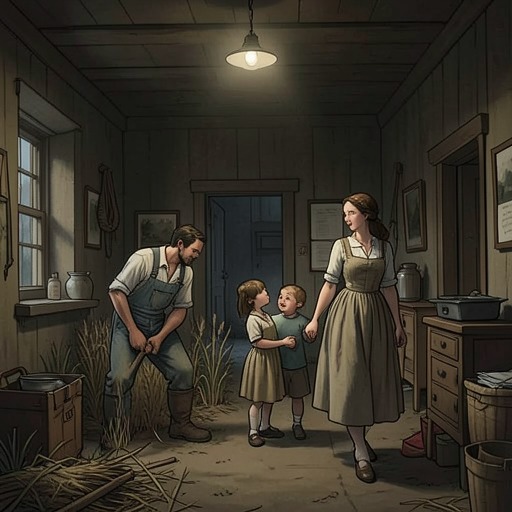
Clutter family home
In Cold BloodThe Clutter family home is presented as both the target of a robbery and the scene of the killings of four members of the Clutter family. In the courtroom account, it is more than a physical setting: Logan Green makes the house the focus of his argument that the crime’s calculated motive and consequences warranted the maximum penalty.
The home as a target
In his closing argument, Logan Green describes the defendants as arriving at the house armed with a shotgun and a dagger, intending to rob and kill. He places money, rather than vengeance or personal hatred, at the center of the crime’s motive. His pointed calculation is that the loot amounted to forty dollars, or ten dollars for each life lost. The house thus enters the trial narrative as the destination of a plan whose claimed financial reward was meager beside its human cost.
The household inside the house
Green evokes the home through the experience of its four occupants: Herbert William Clutter, Bonnie Clutter, Nancy Clutter, and Kenyon Clutter. In his account, Kenyon was restrained within sight of his father’s struggle; Nancy heard gunshots and understood that she might be next. Bonnie, also restrained, was left to hear her husband and children die before the killers entered her room. Green presents these details as part of his prosecution argument to make the household’s vulnerability, and the sequence of loss within the home, vivid to the jury. They are details of the closing speech, not a neutral description of the house’s layout.
The house in the sentencing argument
The home becomes the imagined scene against which the competing appeals at trial are measured. Defense attorneys Arthur Fleming and Harrison Smith had asked the jury for mercy, including by opposing capital punishment. Logan Green answered by asking jurors to picture the Clutter family in their house that night and to consider whether mercy would have been available to them. He warned that a lesser sentence could mean imprisonment followed by escape or parole, and urged the jurors to weigh their own families’ safety. His argument turned the house into the central measure of the trial’s question: whether the defendants should receive mercy or the maximum punishment allowed by law.